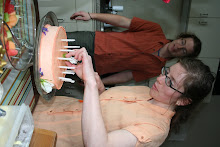
a charming scene from the beloved yorkshire country veterinary story All Creatures Great and Small.
Siegfried Farnon is an outspoken cake appreciator. In this scene his exquisite palate is put to the test unbeknownst to him.
Monday, April 19, 2010


Friday, October 30, 2009
our fig: the first year
In spring 2009 we bought a brown turkey fig tree to grow in a pot on our second-floor balcony.
 In May, our small tree had been home on our porch for a month or two. One of our mothers was very sick, and the fig's progress became a fond topic during hospital visits.
 By August the tree cast a distinctive silhouette. At night, owing to streetlights, the silhouette was cast on our neighbor's house.
 August 2009: a fig on the verge of ripening.

Sunday, April 19, 2009
citrus overload

Marmalade

vin de pamplemousseThis past winter, we subscribed to a winter farm share which sourced produce from all over the east coast. The share was very reasonably priced and kept us away from the dreaded supermarket all winter. Perhaps our favorite part of this weekly box was the tree-ripened organic citrus that appeared every week, 3-4 pieces at a time. Sometime in February we got an additional free box of fruit as reward for turning a friend on to the program. Suddenly we had more citrus than we could eat in a normal way. We gave away some of it, but eventually I was forced to research, then make, large quantities of marmalade.
Last week, our fruit bowl was overfilled with grapefruit, and I searched til I found a recipe for vin de pamplemousse in Chez Panisse Fruit. We're practically teetotalers here, but I thought it might be nice to offer a special aperitif to guests, as Marilla Cuthbert might offer raspberry cordial. So I made a hefty purchase of the requisite spirits (7 bottles in all!) and stirred it all up in a big jar. It will be another month until it's ready to sip.
Both of these efforts made only a small dent in our supply, and I am feeling a bit overwhelmed as all these oranges and grapefruit begin a steady march towards the compost. I would make more marmalade, but I am weary of using so much sugar; I'd make more vin de pamplemousse but I don't have another big jar and wine is expensive in those quantities. Besides, both of these are best when the fruit is not already so tired.
Monday, March 16, 2009
Dosa Review
Dosa are like crepes made from a fermented rice and dal batter instead of flour and eggs. They are cooked to a golden crispiness on an oiled griddle. Typically they are served with a thin stew called sambar, and coconut chutney. There are many variations. Often the dosa are filled with something: spiced potatoes, chutney, sometimes paneer, sometimes meat. But I'm not an expert. My first dosa was in Chicago at a south indian restaurant on Devon St. It was, I believe, a mysore masala dosa, which has potato and something spicy inside. It was huge, impressive looking, but very hot for my palate at the time. It would be years before I considered dosa again. My current dosa fixation was born when I ordered the simplest dosa on the menu at Namaskar, a nearby indian restaurant. The Sada Dosa arrived loosely rolled, measuring perhaps 30" long, nearly overhanging the edge of the table! So crisp, so simple and satisfying, with a bowl of sambar and chutney; I thought of it for days and weeks afterward. Then a friend made masala dosa for us at her home. Homemade, these were just 9" in diameter, but we ate several in a sitting, hot off the tava. I could eat these every day! Then, on a saturday in February we drove 40 minutes to Dosa Temple in Ashland, MA. Yes, Dosa Temple. But our pilgrimage was not rewarded in the way I imagined: I had planned to order multiple dosas at the dosa temple! But Saturday, we now well know, is buffet time, and no menus were offered. We saw no choice but to be swept into the buffet line with everyone else, loading our plates with idlis (dosa's steamed, cake-like cousins, which deserve a separate post), vadas, manchurian gobi and other sticky-handled buffet offerings. Eventually a waiter came by and dropped two small, evenly golden dosa on our table. Complimentary dosa! But only two. We plan to return to Dosa Temple at an off-buffet time.


Inevitably, we made some dosa batter ourselves. There is a good recipe in Wild Fermentation, but we also consulted Yamuna Devi's the Art of Indian Vegetarian Cooking.
Here is our batter after several days of fermentation (aided and accelerated by placing the bowl above an electric space heater set on low):
Not perfect, our dosa-- the first one had the proper golden-ness, but was a bit thick; the last one was undercooked, not golden enough, and maybe too lacy! We'll have to try again.
In the meantime, these are one thing I am quite content to eat in restaurants, cooked to perfection on a 30" tava!
Friday, December 26, 2008
Bûche De Noël 2008
There were a few improvements to this year's yule log cake over last year's. Most notable were the candied orange peel shelf fungus and the pistachio lichen. The orange peels were cut into shelf-shapes before candying, and only the greenest pistachios were chosen for the lichen. I also re-interpreted the recipe and rolled the 11x17" genoise into a longer, slimmer log.


Monday, December 15, 2008
Chole Bhatura
Chole is a spicy and filling bean stew (a chili, if you will!) I get a hankering for sometimes. Traditionally, I'm told, it is served with Bhatura, a tender fried bread that has yogurt and flour fermented together. Recently we went to the trouble to make the two for dinner. Deep-frying is always a bit of a project and usually seems like too much fuss, but there are times when you simply must.
 Once in the hot oil, the bhatura puff up like balloons and are startlingly bouyant in the oil.
 Kala Chana Dal (small black chickpeas) soaking before pressure-cooking.
 Co-incubation in the morning: the dal was brought to a boil then left to soak in the bottom pot, and now the flour and yogurt starter is warm and starting to act in the bowl set on top. Heat-retaining cast iron and stoneware vessels are essential for this. I could have wrapped the whole up in a blanket, too.
 The yogurt-wheat starter fermented and rose slightly.
 The chole, bhatura, some chutney and yogurt. A warming winter meal.
Saturday, November 1, 2008
taffy
 My great-grandmother Pineau pulling taffy.
Halloween, a favorite holiday of many people I know, does not inspire me as I sometimes feel it should. I have had my share of ridiculous costumes (once, I wore a large papier mache nose around... ) and now I have little patience for uncomfortable costumes or elaborate makeup or masks and generally limit myself to human characters I feel affinity for: for two years running, I went as Laura Ingalls Wilder (last year, happily, accompanied by my Almanzo, his manly hand forever covering my smaller, female one as we rode away in the annual Halloween Bike Ride) and the plan for this year was for us to go as Anne of Green Gables and Gilbert Blythe, and we would reinact the schoolhouse scene where Gilbert pulls Anne's braid (carrots!) and she smashes a slate over his head in return. We even reveiwed the PBS miniseries last week to study for these parts. But last night, when it came time to rummage through the closets for suitable clothing, we tried some things on, and then decided not to go. Why? Anne (with beautiful natural red locks) had a headache. I, who was to play Gilbert, was suddenly preoccupied with the notion of making old fashioned molasses taffy and was only too happy to do that instead of bundling up for a late-night bike ride.
For something like fifty years, my grandparents made popcorn balls for all the neighborhood trick-or-treaters. Their recipe was surely from the Joy of Cooking, or else one passed down from great-grandmother Pineau. Bound with a molasses flavored sugar syrup and wrapped in plastic sandwich baggies (perhaps once in waxed paper), this was a wholesome treat that I always looked forward to. You really had to gnaw on it.. I would always be sure to find one with more syrup...
And I had a distant memory of making actual pulled taffy --which is all syrup! My mother spoke of taffy often, and we made it just once, with greased up hands.
So last night, on Halloween, happy that I had all the ingredients (and even a marble slab!), we made taffy-- Anne and I, after a nap. The recipe, again, is in the Joy of Cooking. We pulled and pulled for half an hour or more, then snipped the rope with buttered shears. No trick-or-treaters called.

Monday, October 27, 2008
the garden in october
 lacinato kale, celeriac, lettuces, thyme, sage, and raab against a backdrop of hops and bitter melon.
Friday, September 12, 2008
cycle touring
For our honeymoon, we took our beloved blue Burley Duet tandem bicycle to Nova Scotia via the ferry from Bar Harbor. Upon docking in Yarmouth, we rode to bed and breakfasts and campgrounds, traveling 200 miles overall. We had a grand time and look forward to returning for an extended stay next year.

Here are some of our campsite meals at The Islands Provicial park, one of the wonderful highlights of our trip. We had packed one small pot and some packets of foil. Both supermarkets and farm stands were scarce overall, but near our campground we found both, including a little market that offered spices (as well as brewing and pickling supplies) in bulk.


More pictures of this trip, as well as scenes from our wedding, can be seen here.
Saturday, August 30, 2008
rustic
 Right on the hearth, a blackberry-blueberry tart with a buttery pastry crust. We had just made several pizzas, so the oven was likely still hotter than 500ºF. I placed this one just a bit close to the fire, so it did blacken slightly on one side, but this could be avoided in the future.
Tuesday, August 26, 2008
Almond mountain, our wedding cake

Each of the the three tiers (6", 9", and 12") was made of four layers of almond pound cake filled with rasberry curd-whipped cream and covered with rum buttercream. I decorated with borage and nasturtium flowers and leaves from the gardens of my friends and family. The raspberry curd was made from rasberries my mother picked from my aunt's yard, and the many dozens of eggs (ten or twelve?) that went into each component of the cake were all from hens and ducks (yes, huge duck egg yolks in the buttercream!) which roam in backyards from MA to ME.
I may need to make a separate post about the technical aspects of this cake, but I must mention that one clever idea I had that worked--and I am no fan of shortcuts in foodmaking, normally--I made almond paste using almond flour which I ordered (along with their Queen Guinivere cake flour) from King Arthur. I have become very particular about almond paste, and have found that good almond paste is not something you can buy (it is awful, the stuff I have found in stores, even in the most distinguished specialty shops), but few books I have read suggest making it at home. Fortunately I learned to make almond paste at my grandmother's knee, and tracked down her recipe in the 1975 edition of Joy of Cooking. My old method, when I've made it for marzipan, was to grind the almonds in the blender four times, but using pre-milled almonds saves a heck of a lot of trouble, does not cost more, and as far as I can tell, yields an acceptable result, certainly better than any commercial almond paste I've ever found! I had worried that the pre-ground almond meal would lack oils that freshly ground almonds would have, but the result seemed perfectly acceptable to me.
So worried was I that there would not be enough cake to go around, I made an extra 12" tier as backup! In truth, a cake this size should feed 150. There are still a few chunks of it in fridges around here..
photo courtesy of Drake King
Friday, July 25, 2008


Monday, May 26, 2008
Rosie's birthday cake

Almond hazelnut cake with mascarpone filling and a vanilla bean-flecked custard buttercream decorated with violets and white wild roses.. I also made --somewhat incongruous but delicious in its own right--mint ice cream flavored with a handful of spearmint poached from a then- uncultivated neighboring garden plot. (After eating the cake and ice cream we walked to the garden to find that at last, our garden neighbor had dug the entire plot, and the mint, thyme, oregano and all other perennials had been purged and were nowhere to be found!)
Wednesday, May 21, 2008
Root Beer

Some years ago, we began brewing our own root beer. One of our earliest dates together involved sitting on a park bench, sampling Fentiman's Burdock and Dandelion brew, which led us to contemplate the possibilities of brewing our own soft drinks.
That summer I discovered the restorative properties of a good root beer. If I was frazzled, or suffering from a headache, a bottle of root beer-- which my dear new love seemed always to supply at just the right moment-- would often do the trick. It didn't have to be an exotic variety like Fentiman's, but we soon found that a root beer made from something other than synthetic flavorings was difficult to find.

Eventually we tracked down a book on the subject, amassed a collection of bottles, found an antique bottle capper, and developed a technique to make our own. In spring 2007 we composed the following set of instructions to hand out at the Boston Skillshare.
Root Beer Making at Home
with
Darrah and Rosie
Basic Equipment:with
Darrah and Rosie
Heavy, unthreaded glass bottles, bottle capper, and bottle caps.
Recycled Sam Adams bottles work well!
You can also use screw-top plastic bottles in lieu of glass.
Brew-pot – at least 6 Qt.
A big stainless stock pot works well.
Strainer – to filter the wort.
Jug, carboy or food-grade plastic pail – a five-gallon bucket is ideal.
Sanitizing tub & unscented chlorine bleach (2 tbsp per gallon)
Time-saving Devices:
Racking cane, filler tube, and siphon tubing.
“Jet” bottle washer.
Kitchen scale/gram balance.
Root Beer:
Measurements are given by weight with approximate volume conversions. This recipe is made dried ingredients, but it may be interesting to you to experiment with fresh foraged plant matter also. Cambridge Naturals is a good source for dried herbs and roots. This recipe makes one gallon, but you can easily scale it up. This recipe adapted from one published by Fleishman’s yeast company in 1912.
½ oz. (3 T) sassafras root
½ oz. (3 T) juniper berries
¼ oz. (½ cup) leaf hops
¼ oz (1 T) dandelion root
a few drops wintergreen oil
1 lb sugar
1 gal. water
1/8 t granulated ale yeast
Boil in half the water the roots, berry, and leaf for 20 minutes. Strain. Add sugar and the remaining water. Allow to cool to lukewarm. Dissolve the yeast in a ¼ cup of the liquid, and stir it into the pot. Proceed with bottling. Begin to check carbonation after 18 hours. Refrigerate as soon as it’s ready! KEEP COLD!
Useful References:
Stephen Cresswell, Homemade Root Beer, Soda & Pop. Storey Publishing. 1998.
Euell Gibbons, Stalking the Wild Asparagus. Alan Hood & Co. 1988.
Saunders, Charles, Edible and Useful Wild Plants. Dover. 1976.

Friday, April 25, 2008
garden
At last, just when I had given up hope, our number came up for a community garden plot. 100 square feet of raised bed now ours.
We have already gathered many seeds for favorites that tend not to show up as much as we might like in our CSA share or at the farmer's markets. Broccoli raab, in particular (we have procured a 30-day and a 60-day variety), but also rocket (including a wild, perennial variety), brussels sprouts, bitter melon, fennel, haricot verts... I also have seeds for borage and corn salad which I would like to try again--I had poor luck growing them in containers last year.
We are also going to try growing hops for our root beer. This probably deserves a separate post, but there's not much to tell yet: today I visited the brew store to buy the rhizomes. I chose two noble hops: Mt. Hood and Sterling.
Tuesday, April 22, 2008
fresh pasta

Twice now we have made lasagna and made the noodles for it. I have been using the pasta recipe from Alice Waters' the Art of Simple Food, a book I have used and appreciated a great deal recently.
An interesting revelation regarding the grain:
for today's preparations I coached my dear one over the phone on the modifications I make to this recipe, as he was to mix up the pasta dough before I got home. Some weeks ago, I bought a bag of Bob's Red Mill semolina. It is coarse and yellow. In my first batch of pasta I used half of this semolina, half all-purpose flour. This resulted in a stiff dough that was difficult to roll out by hand (though the finished lasagna was quite delicious). In this house, we also have indian semolina, or sooji, and it is lighter though still coarse. In any case, my companion used the sooji (his culinary predisposition is toward indian food) and a different (lower) proportion of semolina to all-purpose flour, and the result was a wonderfully tender noodle. This substitution led me to appreciate that the atta, or chapati flour we use for making indian parathas and roti is also a durum wheat, and semolina comes from the endosperm of durum wheat.
Monday, April 7, 2008
mustard, a re-issue
The following is a re-issue of an essay first published in May of 2006. That version is no longer available online.
At some point during my middle-elementary school years, I discovered that eating mustard on a cracker was a good way to induce a temporary high. Interestingly, without the cracker or other starchy medium, the mustard had no effect. Many a recess break was spent sitting in the sun with classmates--many of them thrill-seekers I'd otherwise never socialize with--a squeeze bottle of Grey Poupon, and packages of saltines from the cafeteria. A short time later, I was introduced to the fine regional mustards manufactured by Raye's of Eastport, Maine.
At some point during my middle-elementary school years, I discovered that eating mustard on a cracker was a good way to induce a temporary high. Interestingly, without the cracker or other starchy medium, the mustard had no effect. Many a recess break was spent sitting in the sun with classmates--many of them thrill-seekers I'd otherwise never socialize with--a squeeze bottle of Grey Poupon, and packages of saltines from the cafeteria. A short time later, I was introduced to the fine regional mustards manufactured by Raye's of Eastport, Maine.
One of my few restaurant meals while in the Netherlands last month included a bowl of mosterdsoep. It was made with a whole-grain mustard, and had the wonderful flavor of mustard without being overwhelming. Gelderland is, I have since learned, known for its mustard.
In Paris, one of the shopping destinations suggested in my Lonely Planet guide that I thought I might visit but did not quite make it to was the Maille flagship store. While in France I often thought of mustard but never did find myself in one of its better-known provenences.
 Recently on the Boston Natural Areas Network email list, there was sent a bulletin concerning wild garlic mustard--an invasive non-native species that self-seeds aggressively and casts shadows over native wildflowers who would otherwise grow and provide food for wildlife. From a foraging perspective, "wild garlic mustard" is an intriguing name, and it certainly is edible, but the plant really does need to be kept in check. In any case, I did not, until just now, realize what the specimen looked like. All along I assumed it was the more garlicky-looking green shoot that is coming up all over my garden. Turns out it is actually the white-blossomed, toothy-leafed one that I picked the other day to put in a vase in the kitchen.
All this brings me to my present experience wherein I find myself nursing a nasty chemical burn, the result of a remedy involving mustard gone awry. Yes, it was my friend Irina who told me about it to begin with, but I do not hold her in the least bit responsible for the rectangular red welt that now marrs my décolletage. No, I am accustomed to botching naturopathic remedies (some of you may remember my nasty incident with an iron supplement last summer), and if she had not mentioned it to me there is no telling what other trouble I may have found for myself.
In any case, I just googled "mustard burns on the skin" and here is what I found: http://www.gulflink.osd.mil/2d_recon/2d

Jars

Small jars of thoughtfully made and given preserves have become my most treasured refrigerator-door keepsakes.
-two kinds of hot sauce from Tyler, which I have enjoyed with fried eggs on my days off for over a year now.
-from Danny and Corinne, many things: a rather wondrous rosehip and honey preserve, like nothing else I have tasted--I bring it out for pancakes and popovers; once, a quart-jar of unspiced kimchee, which we ate over the course of many weeks as a rejuvenating snack; a jar of Raye's (my longstanding favorite mustard)!
-from Annette, a jar of apple chutney made with apples from a specific state park.
Last year, I gave out a number of jars of strawberry-mulberry jam, a few jars of sauerkraut, some extra spicy kimchee.
Monday, March 3, 2008

Subscribe to:
Posts (Atom)