Friday, July 25, 2008


Monday, May 26, 2008
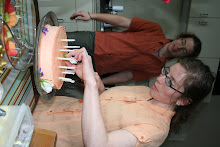
Rosie's birthday cake

Almond hazelnut cake with mascarpone filling and a vanilla bean-flecked custard buttercream decorated with violets and white wild roses.. I also made --somewhat incongruous but delicious in its own right--mint ice cream flavored with a handful of spearmint poached from a then- uncultivated neighboring garden plot. (After eating the cake and ice cream we walked to the garden to find that at last, our garden neighbor had dug the entire plot, and the mint, thyme, oregano and all other perennials had been purged and were nowhere to be found!)
Wednesday, May 21, 2008
Root Beer

Some years ago, we began brewing our own root beer. One of our earliest dates together involved sitting on a park bench, sampling Fentiman's Burdock and Dandelion brew, which led us to contemplate the possibilities of brewing our own soft drinks.
That summer I discovered the restorative properties of a good root beer. If I was frazzled, or suffering from a headache, a bottle of root beer-- which my dear new love seemed always to supply at just the right moment-- would often do the trick. It didn't have to be an exotic variety like Fentiman's, but we soon found that a root beer made from something other than synthetic flavorings was difficult to find.

Eventually we tracked down a book on the subject, amassed a collection of bottles, found an antique bottle capper, and developed a technique to make our own. In spring 2007 we composed the following set of instructions to hand out at the Boston Skillshare.
Root Beer Making at Home
with
Darrah and Rosie
Basic Equipment:with
Darrah and Rosie
Heavy, unthreaded glass bottles, bottle capper, and bottle caps.
Recycled Sam Adams bottles work well!
You can also use screw-top plastic bottles in lieu of glass.
Brew-pot – at least 6 Qt.
A big stainless stock pot works well.
Strainer – to filter the wort.
Jug, carboy or food-grade plastic pail – a five-gallon bucket is ideal.
Sanitizing tub & unscented chlorine bleach (2 tbsp per gallon)
Time-saving Devices:
Racking cane, filler tube, and siphon tubing.
“Jet” bottle washer.
Kitchen scale/gram balance.
Root Beer:
Measurements are given by weight with approximate volume conversions. This recipe is made dried ingredients, but it may be interesting to you to experiment with fresh foraged plant matter also. Cambridge Naturals is a good source for dried herbs and roots. This recipe makes one gallon, but you can easily scale it up. This recipe adapted from one published by Fleishman’s yeast company in 1912.
½ oz. (3 T) sassafras root
½ oz. (3 T) juniper berries
¼ oz. (½ cup) leaf hops
¼ oz (1 T) dandelion root
a few drops wintergreen oil
1 lb sugar
1 gal. water
1/8 t granulated ale yeast
Boil in half the water the roots, berry, and leaf for 20 minutes. Strain. Add sugar and the remaining water. Allow to cool to lukewarm. Dissolve the yeast in a ¼ cup of the liquid, and stir it into the pot. Proceed with bottling. Begin to check carbonation after 18 hours. Refrigerate as soon as it’s ready! KEEP COLD!
Useful References:
Stephen Cresswell, Homemade Root Beer, Soda & Pop. Storey Publishing. 1998.
Euell Gibbons, Stalking the Wild Asparagus. Alan Hood & Co. 1988.
Saunders, Charles, Edible and Useful Wild Plants. Dover. 1976.

Friday, April 25, 2008
garden
At last, just when I had given up hope, our number came up for a community garden plot. 100 square feet of raised bed now ours.
We have already gathered many seeds for favorites that tend not to show up as much as we might like in our CSA share or at the farmer's markets. Broccoli raab, in particular (we have procured a 30-day and a 60-day variety), but also rocket (including a wild, perennial variety), brussels sprouts, bitter melon, fennel, haricot verts... I also have seeds for borage and corn salad which I would like to try again--I had poor luck growing them in containers last year.
We are also going to try growing hops for our root beer. This probably deserves a separate post, but there's not much to tell yet: today I visited the brew store to buy the rhizomes. I chose two noble hops: Mt. Hood and Sterling.
Tuesday, April 22, 2008
fresh pasta

Twice now we have made lasagna and made the noodles for it. I have been using the pasta recipe from Alice Waters' the Art of Simple Food, a book I have used and appreciated a great deal recently.
An interesting revelation regarding the grain:
for today's preparations I coached my dear one over the phone on the modifications I make to this recipe, as he was to mix up the pasta dough before I got home. Some weeks ago, I bought a bag of Bob's Red Mill semolina. It is coarse and yellow. In my first batch of pasta I used half of this semolina, half all-purpose flour. This resulted in a stiff dough that was difficult to roll out by hand (though the finished lasagna was quite delicious). In this house, we also have indian semolina, or sooji, and it is lighter though still coarse. In any case, my companion used the sooji (his culinary predisposition is toward indian food) and a different (lower) proportion of semolina to all-purpose flour, and the result was a wonderfully tender noodle. This substitution led me to appreciate that the atta, or chapati flour we use for making indian parathas and roti is also a durum wheat, and semolina comes from the endosperm of durum wheat.
Monday, April 7, 2008
mustard, a re-issue
The following is a re-issue of an essay first published in May of 2006. That version is no longer available online.
At some point during my middle-elementary school years, I discovered that eating mustard on a cracker was a good way to induce a temporary high. Interestingly, without the cracker or other starchy medium, the mustard had no effect. Many a recess break was spent sitting in the sun with classmates--many of them thrill-seekers I'd otherwise never socialize with--a squeeze bottle of Grey Poupon, and packages of saltines from the cafeteria. A short time later, I was introduced to the fine regional mustards manufactured by Raye's of Eastport, Maine.
At some point during my middle-elementary school years, I discovered that eating mustard on a cracker was a good way to induce a temporary high. Interestingly, without the cracker or other starchy medium, the mustard had no effect. Many a recess break was spent sitting in the sun with classmates--many of them thrill-seekers I'd otherwise never socialize with--a squeeze bottle of Grey Poupon, and packages of saltines from the cafeteria. A short time later, I was introduced to the fine regional mustards manufactured by Raye's of Eastport, Maine.
One of my few restaurant meals while in the Netherlands last month included a bowl of mosterdsoep. It was made with a whole-grain mustard, and had the wonderful flavor of mustard without being overwhelming. Gelderland is, I have since learned, known for its mustard.
In Paris, one of the shopping destinations suggested in my Lonely Planet guide that I thought I might visit but did not quite make it to was the Maille flagship store. While in France I often thought of mustard but never did find myself in one of its better-known provenences.
 Recently on the Boston Natural Areas Network email list, there was sent a bulletin concerning wild garlic mustard--an invasive non-native species that self-seeds aggressively and casts shadows over native wildflowers who would otherwise grow and provide food for wildlife. From a foraging perspective, "wild garlic mustard" is an intriguing name, and it certainly is edible, but the plant really does need to be kept in check. In any case, I did not, until just now, realize what the specimen looked like. All along I assumed it was the more garlicky-looking green shoot that is coming up all over my garden. Turns out it is actually the white-blossomed, toothy-leafed one that I picked the other day to put in a vase in the kitchen.
All this brings me to my present experience wherein I find myself nursing a nasty chemical burn, the result of a remedy involving mustard gone awry. Yes, it was my friend Irina who told me about it to begin with, but I do not hold her in the least bit responsible for the rectangular red welt that now marrs my décolletage. No, I am accustomed to botching naturopathic remedies (some of you may remember my nasty incident with an iron supplement last summer), and if she had not mentioned it to me there is no telling what other trouble I may have found for myself.
In any case, I just googled "mustard burns on the skin" and here is what I found: http://www.gulflink.osd.mil/2d_recon/2d

Subscribe to:
Posts (Atom)